Do You Need To Innovate The Innovation Process?


Innovation is more nuanced than the simple definition "new product, process, or idea". Innovation can be categorized between radical and incremental where the difference between the two is substantial.
Radical Vs. Incremental Innovation
Incremental innovation entails making small, continuous enhancements and optimizations to current products, services, or processes. In contrast, radical innovation involves implementing major, groundbreaking changes that disrupt industries and establish entirely new standards.
Impact of Different Innovation Processes
The research by Peter Robbins and Colm O’Gorman "Innovating the innovation process: an organisational experiment in global pharma pursuing radical innovation" discusses an organizational experiment in a leading pharmaceutical company aimed at enhancing the generation of radical innovation ideas. The experiment involved an internal innovation tournament that led to the creation of 33 new product ideas, 14 of which were considered radical. The two intra-company teams varied in geographical (UK and US) and, hence, ideological differences in approach. This initiative not only resulted in innovative product ideas but also led to a reorganization of how the company approaches radical innovation. Key arguments include the significance of team leadership and the innovation process in producing radical ideas, and the impact of incorporating consumer feedback on innovation outcomes.
From the innovation tournament we learn that the innovation journey or innovation process for radical innovation is inherently complex because typically they involve the following: high levels of technical expertise; high levels of creativity; extensive search; engagement with new, external partners; and an understanding of current and likely future market demand
In managing for radical innovation, the standard processes that work for incremental innovation may not be useful.
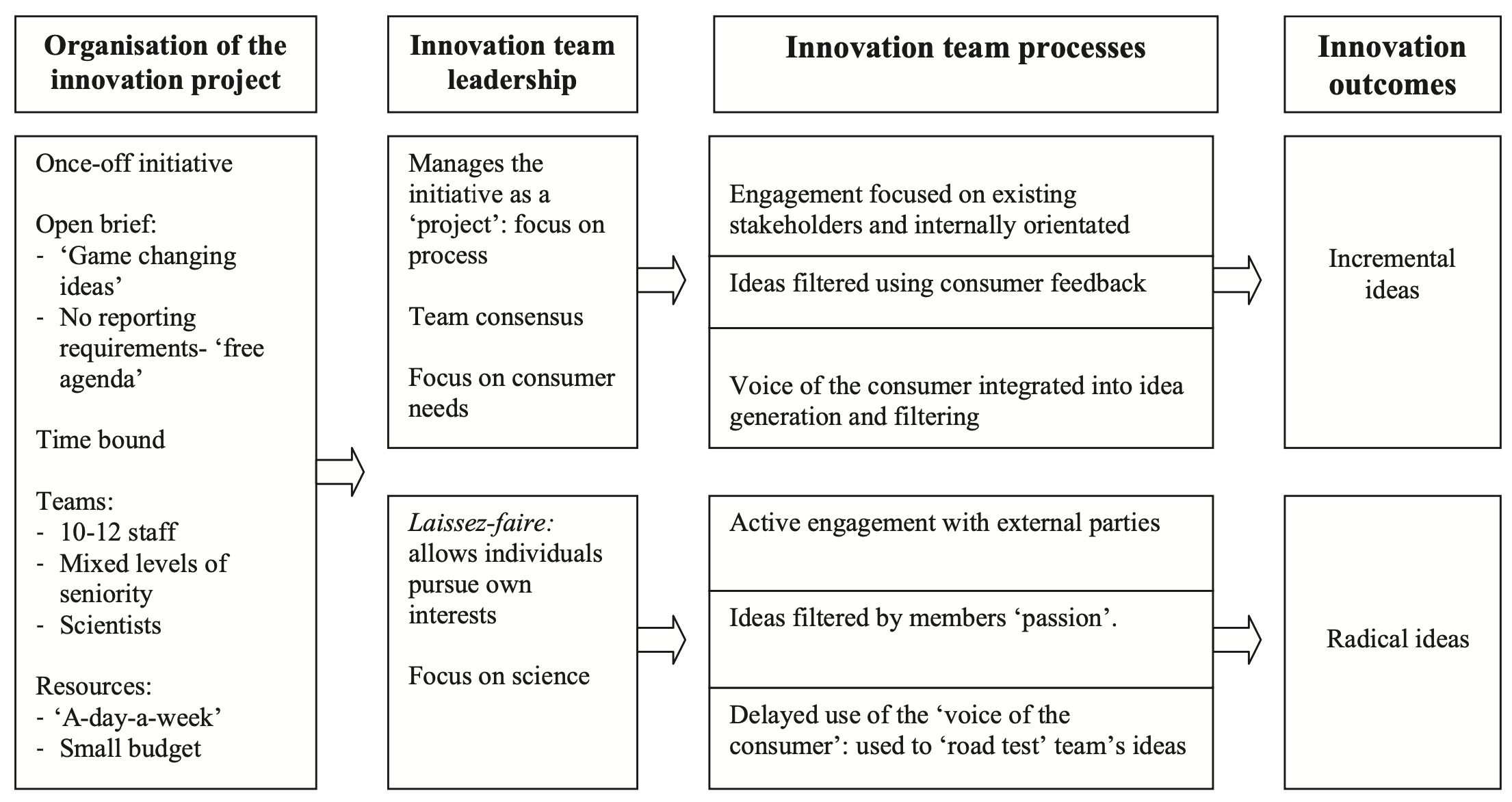
From the figure above we can see how:
Innovation Leadership and Interpretation of the Innovation Process
The study highlights the crucial role of team leadership in the innovation process, particularly at the fuzzy front end, where ideas are initially generated and developed. The two team leaders in the study had different interpretations of their roles and approached the innovation process distinctly. The UK team leader, a scientist, focused on leveraging scientific expertise and technology to drive innovation, avoiding formal processes. In contrast, the US team leader, experienced in project management, adopted a more structured approach, emphasizing the need to meet the project brief with quantitatively tested concepts. This divergence in leadership styles and interpretations of the innovation process significantly influenced the nature and outcomes of the innovation efforts.
Generating New Radical Ideas Through External Engagement
The paper discusses how the UK team's active engagement with external networks, including discussions with internal experts and external collaboration partners, facilitated the generation of radical innovation ideas. This approach contrasts with the US team, which primarily relied on internal ideation and only engaged externally to validate an idea already under discussion. The UK team's openness to external ideas and technologies, facilitated by the team leader's efforts to connect with innovation intermediaries and encourage team members to meet with field experts, injected fresh perspectives into the innovation process, contributing to the development of more radical ideas.
Idea Prioritization and the Role of Passion vs. Consumer Feedback
The paper explores the challenges both teams faced in prioritizing ideas for the final presentation. The US team used consumer feedback to guide their decisions, allowing ideas favored by consumers to progress. This approach, while structured, tended to favor incremental innovations that appealed to existing customer segments. Conversely, the UK team, led by the belief in the importance of scientific innovation, prioritized ideas based on team members' passion and enthusiasm for the science behind them. This approach allowed more radical ideas to be pursued but also introduced challenges in decision-making due to personal biases and the potential for conflict among team members.
Integrating the Voice of the Consumer
The study contrasts the two teams' approaches to incorporating consumer insights into the innovation process. The US team integrated consumer feedback early and used it to make go/no-go decisions on projects, which was seen as a valuable learning experience by the team members. In contrast, the UK team leader chose to focus on the scientific aspects of innovation, avoiding market research to prevent diluting the team's focus on potentially groundbreaking ideas. This difference underscores the tension between leveraging consumer insights to ensure market relevance and maintaining a focus on scientific exploration to achieve radical innovation.
Innovation Outcomes and Organisational Implications
The experiment led to a significant rethinking within the organization about managing innovation, especially the balance between radical and incremental innovation. The distinct outcomes of the two teams demonstrated the need for different organizational structures and processes to support the varying nature of innovation activities. The experience from the RIT initiative influenced the organization's approach to innovation management, leading to the establishment of new structures like the White Space team to specifically seek out radical innovation opportunities.