Challenges and Strategies of Matrix Organizations


Journal: Challenges and Strategies of Matrix Organizations: Top-Level and Mid-Level Managers’ Perspectives
Authors: Thomas Sy and Laura Sue D’Annunzio
Matrix is a grid-like organizational structure that allows a company to address multiple business dimensions using multiple command structures.
Variants of the matrix:
- Functional
- Balanced
- Project
The matrix allows companies to leverage vast resources while staying small and task-oriented. The matrix encourages innovation and fast action, and speeds information to those who know how to use it. Conversely, the matrix can be complex and unpredictable. It violates the traditional principles of authority, tending to breed ambiguity and conflict. The matrix also can require more managerial and administrative support at a time when companies appear to be cutting back.
4 primary reasons CEOs adopt the matrix:
- Allows companies to focus on multiple business goals;
- Facilitates the management of information;
- Enables companies to establish economies of scale; and
- Speeds response to environmental demands
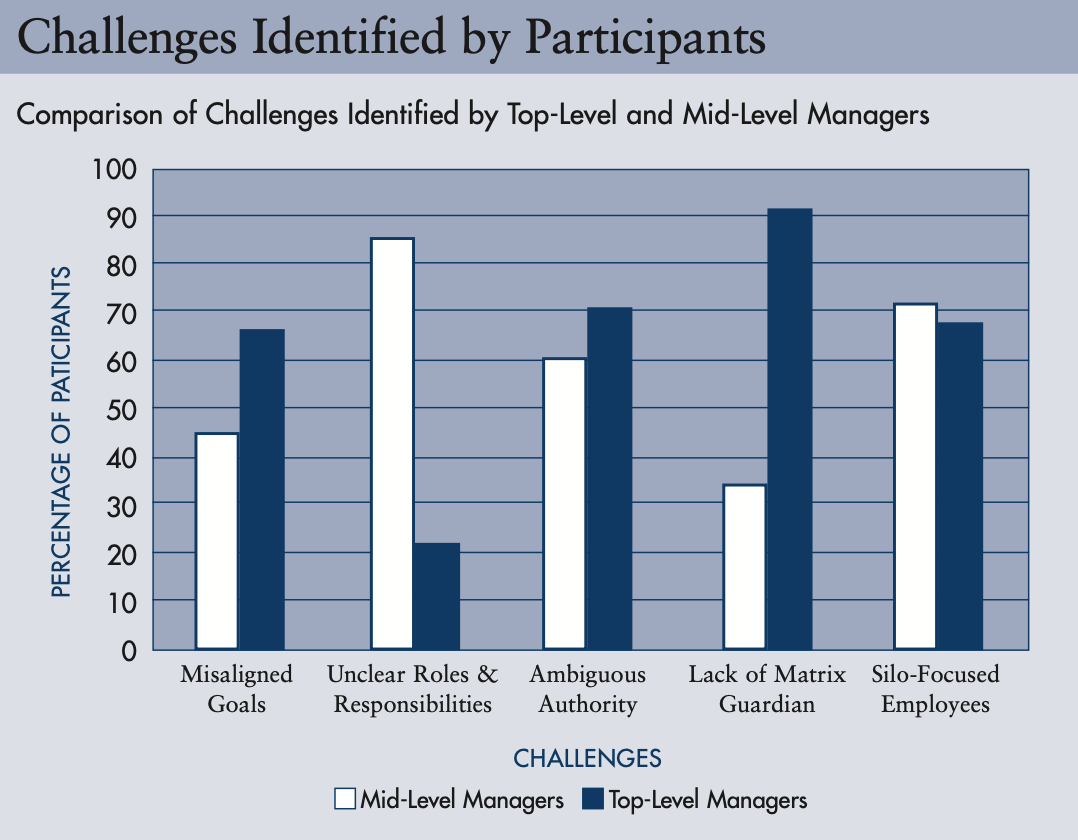
Let's dive into the top 5 common challenges faced. Comparison done between top-level and mid-level done to show differences in challenges faces across hierarchies.
Misaligned Goals
This finding suggests that misaligned goals are perhaps more relevant for top-level managers than for mid-level managers.
Overall, participants cited the following difficulties in goal alignment:
- Competing or conflicting objectives between matrix dimensions
- Inadequate processes to align goals and detect possible misalignments
- Lack of synchronization, coordination, and poor timing of work plans and objectives
- Insufficient communication and consultation between matrix dimensions
How do matrix organizations handle conflicting goals? Participants say they establish processes to ensure that their goals and metrics are aligned. For example, a manager at another automotive manufacturer in our study uses “[[Cascading spreadsheet planning]]” charts (Galbraith, 2000) to align goals. Through cascading spreadsheet planning the company begins each planning year by setting goals and cascading them vertically and horizontally throughout the organization.
Unclear Roles and Responsibilities
Common problem in almost all matrix organizations.
As organizations adapt to changing business environments and customer demands, employees’ roles and responsibilities must adapt as well (Bartlett & Ghoshal, 1990; Kilmann, 1985)
Solution: RASIC
Once tasks and responsibilities are identified, employees go through a process of completing the chart using letters from the RASIC acronym: R=Responsible, A=Approval, S=Support, I=Inform, C=Consult.
RASIC does more than just clarify roles and responsibilities. It involves employees in the process and empowers them to act in unfamiliar situations.
Ambiguous Authority
In a traditional hierarchal structure, leadership rights are quite clear: Authority equals responsibility.
Leaders generally view their roles as taking charge and making the tough calls and are not accustomed to sharing decision rights. This lack of experience in collaborative decision-making creates ambiguity
In the matrix, leaders can have responsibility without authority as a result of the dual reporting structure. For example, in a matrix, the HR function could have responsibility for instituting a global policy but have no authority for implementing it at regional levels.
Matrix Guardian
Most organizations are keenly aware of the importance of measuring performance.
what gets measured, gets done
Surprisingly, few companies track the performance of their matrix structure to understand how well the company operates.
Compared with mid-level managers, more top-level managers believe that the matrix guardian is a key success factor for optimal matrix performance.
The key issues associated with the matrix guardian are:
- Lack of consequences and rewards for matrix performance.
- Establishing a monitoring process to detect and identify matrix performance problems.
- Ensuring the matrix guardian has senior level support and authority to take action
- Preserving the objectivity of the matrix guardian and preventing undue political pressure
Silo-Focused Employees
Most critical challenge faced by matrix organizations
Unfortunately, most employees in large organizations tend to be silo-focused: They view their membership, and loyalty, as belonging to a certain subunit in the organization.
Two primary reasons for silo-focused behaviour:
- Most employees reside in the same function (and often the same unit within the function) throughout their careers.
- Matrix structures require high degrees of collaboration compared to traditional single-report hierarchical structures; therefore, employees have not developed certain interpersonal skills that are necessary to work with other elements of the organization.
Best practices for leaders to increase collaboration and develop a single-firm mindset:
- Define Expectations: The company that defines expectations up-front is better equipped to get employees aboard.
- Provide Training: Successful matrix organizations provide ongoing training designed to reinforce desired behaviors. The goal of the ongoing training is to infuse a common vision and value system, and broaden employees’ perspectives and skills
- Work Across Functions: Companies that provide cross-functional work experience say their employees grasp the matrix concept more quickly and more effectively.
- Build Relationships: Employees who operate most effectively within the matrix are those who deliberately reach out and create an informal network of peers and supporters. Informal net- works tend to be more valuable than formal networks because they hasten the job of obtaining buy-in and resources for executing business initiatives (Hodgetts, 1968).